How to Read the Anion Gap in Emergency Medicine
What is the anion gap?
The anion gap is a rapid test clue used to assist in identifying metabolic acidosis and related acid-base disorders. It comes from standard serum electrolytes, especially serum sodium, serum chloride, and serum bicarbonate. In emergency evaluation, it helps clinicians detect an electrolyte imbalance that may point to hidden acids, toxins, or organ failure.
The idea behind the anion gap is straightforward: measured cations and measured anions in the blood should be equal, but they never do perfectly because some ions are not directly measured. These unmeasured anions create the “gap.” A higher gap suggests increased acid accumulation or retained acids, while a normal gap usually means bicarbonate loss is being matched by chloride gain.
In clinical practice, the anion gap is not a diagnosis. It is a diagnostic clue that supports acid-base interpretation and helps shape the differential diagnosis. For example, a patient with vomiting, hypotension, or altered mental status may have a distinct cause of acidosis depending on whether the anion gap is high, normal, or corrected for albumin.
Most emergency clinicians think of the anion gap as part of a broader serum chemistry review. It should never be interpreted in isolation. The context of vital signs, perfusion, lactate, renal function, glucose, ketones, and exposure history matters just as much as the number itself.
How can an anion gap calculator work?
An Anion Gap Calculator uses the usual lab values for sodium, chloride, and bicarbonate to determine the gap. Its core formula is:
Anion gap = serum sodium - (serum chloride + serum bicarbonate)
This anion gap calculation is quick, but the result should be interpreted with awareness of the lab’s reference range. Several analyzers and institutions may report slightly different normal values, so a number that seems abnormal in one system may be near-normal in another.
This tool is particularly helpful when a patient has an unexplained metabolic derangement. A low bicarbonate level alone tells you there is acidosis or bicarbonate loss, but the anion gap helps differentiate high anion gap metabolic acidosis from normal anion gap metabolic acidosis. That distinction reduces the cause and supports urgent management.
Modern calculators may also include albumin correction. Because albumin is a negatively charged protein, low albumin can hide an elevated gap. A calculator that adjusts for albumin gives a more accurate corrected value and improves clinical decision-making, especially in patients with critical illness.
In a busy emergency department, the tool is most helpful when paired with the rest of the presentation. The number alone is not enough; the question is what the number means for immediate care. A modest abnormality may be benign in one patient and a warning sign of shock, poisoning, or organ failure in another.
What does a high anion gap mean in the ER?
A high anion gap usually indicates there are surplus acids in the blood or decreased clearance of those acids. In acute care, the most important patterns include high anion gap metabolic acidosis caused by lactic acidosis, ketoacidosis, renal failure, and various toxins. The gap is often the earliest lab clue that a patient has a major systemic problem.
Lactic acidosis is frequent in systemic hypoperfusion, sepsis, severe hypoxia, seizures, and shock. Lactate rises when tissues are underperfused or metabolically stressed. In these cases, the anion gap helps identify the problem early, but the true priority is locating and reversing the cause of poor perfusion.
Ketoacidosis can occur in diabetic ketoacidosis, starvation, or alcohol-related states. Here, the gap rises because ketone production leads to organic acid accumulation and bicarbonate consumption. A patient may present with dehydration, tachypnea, abdominal pain, and altered mentation. The gap is a valuable clue, but glucose, ketones, and volume status determine treatment.
Renal failure can also elevate the gap because failing kidneys cannot excrete acids effectively. Uremic toxins and retained acids accumulate, creating a progressive metabolic acidosis. This is one reason kidney function should be reviewed whenever the gap is elevated without an obvious explanation.
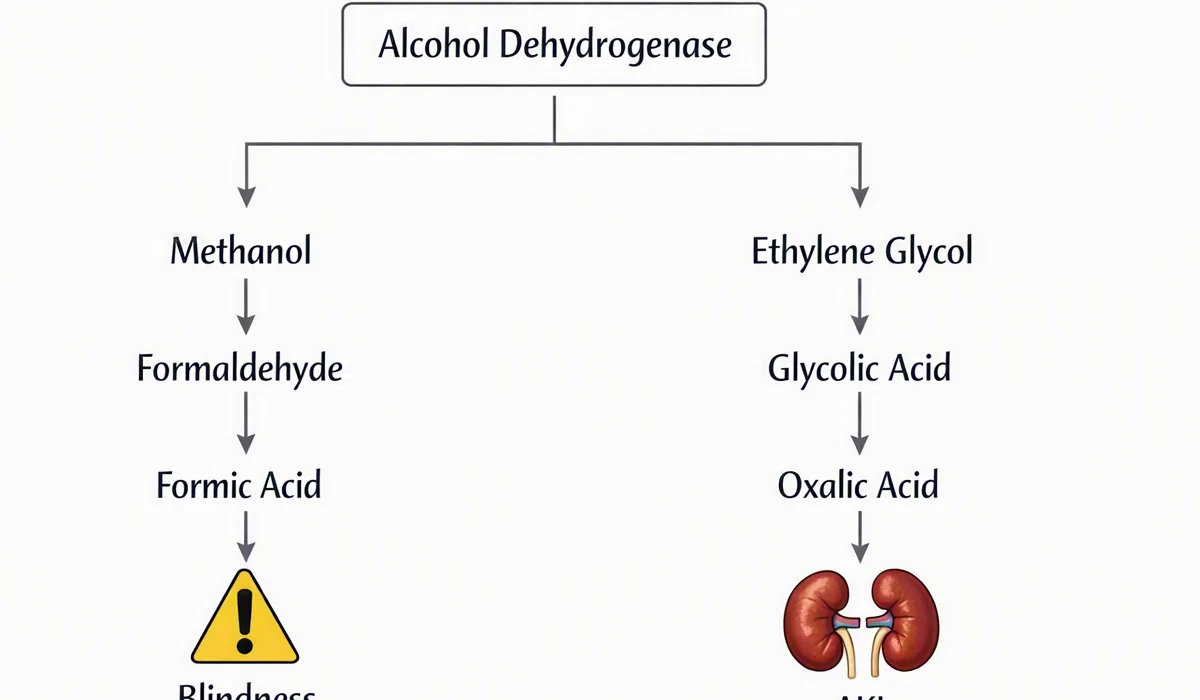
In toxicology, the anion gap can point toward toxic alcohols or salicylate poisoning. Toxic alcohols may initially produce a high gap before worsening into severe acidosis and end-organ injury. Salicylates can cause a mixed acid-base picture that may include respiratory alkalosis and metabolic acidosis, so the gap becomes a useful but incomplete clue. A suspicious toxidrome should trigger immediate evaluation rather than reassurance from a single lab value.
For ED clinicians, the important step is to link the lab pattern to urgent management. A widened anion gap is not managed directly; the root cause is addressed. The gap simply indicates that the body has an acid burden that needs clarification.
What is behind a normal anion gap metabolic acidosis?
This type of metabolic acidosis is usually caused by bicarbonate loss or poor bicarbonate replacement, with chloride rising to preserve electrical balance. This condition is commonly called hyperchloremic acidosis. It is common in emergency care and can be overlooked if the focus stays only on the presence of acidosis rather than the pattern.
One of the main causes is diarrhea. Gastrointestinal bicarbonate loss can be substantial, especially with severe or ongoing volume depletion. In this setting, the body loses base through the gut, serum bicarbonate drops, and serum chloride tends to increase.
Renal tubular acidosis is an additional major cause. Here, the kidneys fail to acidify urine or reclaim bicarbonate properly. The result is a normal gap acidosis despite ongoing acid-base stress. This should be considered when the patient has persistent acidosis without a clear GI source.
Direct bicarbonate loss can also occur through drainage, fistulas, or iatrogenic causes. Chloride-rich fluid resuscitation may play a role as well, especially after high-volume saline administration. In practice, this means not every low bicarbonate state with a normal gap is due to a single disease; it may reflect treatment-related shifts or a mixed picture.
Emergency clinicians should remember that normal gap acidosis can still be clinically serious. It may reflect significant volume depletion, ongoing GI losses, kidney dysfunction, or a hidden mixed disorder. The absence of a high gap does not mean the patient is safe.
How will albumin influence the anion gap?
Albumin is a major unmeasured anion, so changes in albumin significantly affect anion gap interpretation. When albumin is reduced, the measured gap can seem falsely normal or only mildly elevated. This is why hypoalbuminemia is such an critical consideration in acute care, especially in patients with severe infection, malnutrition, liver disease, or critical illness.
The concept of albumin correction helps uncover hidden metabolic acidosis. If albumin is reduced, the corrected anion gap may be much higher than the raw calculation suggests. This matters because a patient with low albumin can still have a significant acid load even when the initial number looks reassuring.
Many clinicians use a corrected formula that modifies the gap upward when albumin is low. The exact albumin correction formula may change by institution, but the practical principle is the same: lower albumin lowers the expected gap, so you must adjust for it. This prevents underestimating the severity of acidosis.
In real-world care, corrected interpretation can shift the diagnostic direction. A borderline gap in a patient with hypoalbuminemia may actually represent significant lactic acidosis, ketoacidosis, or toxin exposure. That is why albumin should be viewed as part of every serious acid-base workup, not an optional extra.
Ultimately, albumin-aware interpretation enhances the accuracy of emergency decision-making. Without it, the clinician may miss a dangerous corrected value and delay the next steps in care.
What’s the stepwise emergency medicine method to assessment?
An effective emergency medicine method starts with the patient, not the calculator. First assess the airway, breathing, circulation, mental status, and perfusion. After that use the lab pattern to support the acid-base disorders workup. The anion gap should be one piece of the full clinical picture.
First step: Establish the acid-base status. Check the serum bicarbonate and obtain an ABG or venous blood gas when needed. The blood gas helps determine pH, respiratory compensation, and whether a mixed disorder is present.
Step 2: Calculate the anion gap. Apply the Anion Gap Calculator or the standard formula with current serum values. Match the result with your lab’s reference range and remember that small differences can matter in sick patients.
Third step: Check albumin and correct the gap. If albumin is low, apply albumin correction. A corrected gap may reveal a concealed high-gap state, especially in critical illness.
Step 4: Look for the major causes. If the gap is high, think about lactic acidosis, ketoacidosis, renal failure, toxic alcohols, and salicylate poisoning. If the gap is normal, consider diarrhea, renal tubular acidosis, or other causes of bicarbonate loss.
Fifth step: Use the delta gap when appropriate. The delta gap helps identify a mixed disorder. If the rise in anion gap does not match the fall in bicarbonate, another acid-base process may be clinical relevance of AG present. This is especially helpful when a patient has vomiting, renal disease, or chronic CO2 retention alongside acute acidosis.
Step 6: Reassess in context. The lab result should guide the differential diagnosis, not replace it. Check glucose, lactate, ketones, creatinine, osmolar gap if indicated, medication history, and exposure history. A complete emergency evaluation is about pattern recognition plus rapid action.
This step-by-step method makes the anion gap more than a number. It becomes a structured tool for recognizing danger, refining the diagnosis, and choosing the next intervention.
When should the anion gap trigger urgent action?
The anion gap calls for immediate attention when it appears in a patient with hemodynamic instability or symptoms of critical disease. This includes shock, sepsis, altered mental status, severe tachypnea, suspected toxic ingestion, or evidence of organ failure. In these situations, the gap is not just a lab abnormality; it is a warning sign of potentially life-threatening pathology.
Marked gap acidosis in shock or sepsis may reflect escalating lactic acidosis from poor perfusion. The priority is immediate resuscitation, source control, cultures, antibiotics when appropriate, and hemodynamic support. Trying to wait it out is usually the wrong move when the patient is unstable.
Possible toxic ingestion requires immediate attention because delays can worsen outcomes. Toxic alcohols and salicylate poisoning may progress quickly and can present with deceptively nonspecific symptoms. In these cases, emergency clinicians should act on the clinical picture and not depend solely on confirmatory testing.
The gap should also raise concern in patients with severe ketoacidosis, worsening renal failure, or rapid respiratory compensation. These patients may need fluid resuscitation, insulin, bicarbonate in select circumstances, dialysis consideration, or ICU-level observation. That is where the anion gap becomes a bridge to critical care.
In short, urgent action is needed when the gap supports a dangerous diagnosis and the patient is clinically ill. The calculator helps flag the abnormality, but timely treatment comes from recognizing the whole syndrome.
Frequently seen questions
What counts as a normal anion gap in emergency medicine?
The reference range for anion gap depends on the laboratory method and local normal range. A common emergency medicine estimate is a typical range as roughly around the low teens, but you should always use your institution’s values. The key is not memorizing one universal number; it is recognizing when the result is abnormal for that lab and context.
How is the anion gap corrected for low albumin?
Albumin correction modifies the measured gap upward when albumin is low, because hypoalbuminemia can mask a true acidosis. The exact albumin correction formula varies, but the general idea is to estimate the missing contribution from albumin and add it to the measured gap. This provides a more accurate corrected result for anion gap assessment.
What are the common causes of high anion gap?
The most common causes include lactic acidosis, ketone acidosis, renal insufficiency, alcohol toxins, and aspirin toxicity. These causes produce elevated anion gap acidosis through acid accumulation, reduced clearance, or both. In emergency medicine, these diagnoses are high priority because they may require immediate treatment.
Can serious illness still present with a normal anion gap?
Yes. A patient can have metabolic acidosis with a normal anion gap and still be seriously ill. Examples include severe profuse diarrhea, tubular renal acidosis, and significant loss of bicarbonate. The absence of a high gap does not rule out important disease, so the full clinical picture still matters.
How is an anion gap calculator best used in practice?
Use the Anion Gap Calculator as part of the emergency evaluation, not as a standalone answer. Start with the patient’s stability, then review serum sodium, blood chloride, and serum bicarbonate, apply albumin adjustment if needed, and interpret the result in the context of acid-base acidosis and other acid-base disturbances. The calculator is most useful when it helps move quickly from lab values to the right differential diagnosis and urgent management plan.